- Effortless Calm
- Posts
- 9 Reasons to be Mediocre
9 Reasons to be Mediocre
Mediocrity might be the key to a calm, fulfilling life

Sean Stews
October 09, 2022

As I write this, I'm about to become a dad at any moment.
It's a surreal experience walking through my days knowing that at any moment, my life will fundamentally change. Of course, that's always the case - but it's currently un-ignorable.
In this "fully awake" state, what's important becomes clear. Namely, relaxing into life and enjoying moments as much as possible.
It feels different from my usual state, which is dominated by an itching sense that I always need to be learning, mastering something, improving, and growing: The "self-help" trap that I continually fall into - and will no doubt fall into again when my life slips back into it's habits.
From a young age, we're conditioned to strive for excellence.
Get good grades, win the sport, train hard, learn more, get a good job, get a promotion. Climb, climb, grow, grow, sprint, sprint.
It's stressing us out.
My happiest and most peaceful moments are the ones where I subvert this pace and become okay with letting go and doing whatever the opposite of "crushing it" is.
Let's call it deliberate mediocrity.
The seeds of this article we're planted a year ago - but I've updated and expanded it here - because it's one of the pieces I'm proudest of and I needed the reminder to slow down right now.
To be okay with being "just okay."
To step off the "growth" treadmill.
When you do, you might be surprised at how much further your mediocre steps take you than "hustling."
Here's 9 good reasons to be mediocre:
1. Save your most precious resource
Effort is a limited resource. Save it for the important stuff:
Family
Friends
Your personal goals
Outside of whatever 2-3 things you want your life to be about, be intentionally "meh" at everything else.
Being excellent is inefficient, and it's only worth the inefficiency for the big stuff.
Nate Soares calls this idea "wasted motion" in his article Half-assing it with everything you've got:
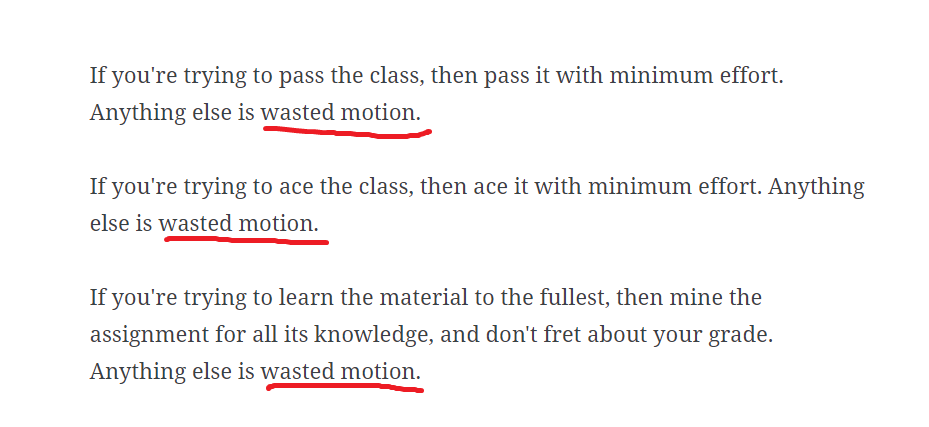
2. Free your identity
We tangle ourselves up with identities: "I don't draw because I'm not an artist." "I don't dance because I'm not a dancer."
When you put yourself in a cage of labels, it's easy to forget: no one was "a writer" before they wrote something mediocre. Then, suddenly, they were.
In contrast, being mediocre makes your identity lighter. Spreads it around like dandelion wisps.
I can be:
A juggler today
A Python coder tomorrow
A ballerina next October
It doesn't matter if I suck at all three pursuits, because none of them define me.

Being bad at things diversifies your identity portfolio. And when the weight of your identity doesn't hang on one thing, you're free to explore more.
3. Boost your energy
Desire is energizing.
Being mediocre - by definition - "leaves something to be desired."
Desire is an itch you can't scratch. We like these itches. When we scratch one, we look for others.
Being mediocre guarantees you always have a higher level to strive for. Some call this feeling of alive, open eagerness "beginners mind".

4. Reduce all-or-nothing thinking
"All-or-nothing" thinking is a cognitive distortion (from Cognitive Behavioral Therapy) where you think in binaries:
Either/or
Success or failure
Everything or nothing
Nuanced thinking is important. It keeps anxiety, depression, and overwhelm at bay.
If you're nervous about something:
A hard conversation
A presentation at work
A first date
...ask yourself what a mediocre outcome might look like. The mediocre outcomes is the most likely outcome and the most comforting to imagine.
Deliberate mediocrity is like exposure therapy for all-or-nothing thinking: If you're a Michelin Star chef, you're either perfect or you're not. But if you're an average cook, your "meh" lasagna is proof of a middle ground.
Engaging regularly in mediocrity lets you embody the comforting concept that the world doesn't operate in binary.

5. Unlock joy
Kids are mediocre at everything.
They don't care about "moving the needle" or "boosting productivity." A cardboard box = an afternoon of joy.

Drop the need to excel. There's childlike joy in being an average...
painter
writer
surfer
coder
singer
dancer
"demanding excellence in all that we do... steals from us one of life’s greatest rewards — the simple pleasure of doing something you merely, but truly, enjoy."
6. Overcome procrastination
Being mediocre is the cure to procrastination.
In my favorite article on procrastination, Oliver Burkeman identifies two reasons we procrastinate:
1. The Importance Trap
2. The Consistency Trap
Here's a quick distillation of each trap and how mediocrity gets you out of both...
Trap #1: The Importance Trap: The more a task matters to you, the more energy, focus, and time you think it will take. And the less you feel ready to do it.
When you decide to organize your entire desk before sitting down to work, that's the Importance Trap. We delay the big, hairy task that bring us face to face with mediocrity.
Instead, expecting and welcoming mediocrity removes the friction of starting - giving your hairiest task a clean shave and freeing you from The Importance Trap.
Trap #2: The Consistency Trap: "The assumption that something’s not worth doing until your life’s arranged to do it regularly." Habits are all the rage. But not everything needs to become one.
The mediocre aren't concerned with consistency. They don't hesitate to do meaningful work, even if it can only be done once. Once is better than never.
7. Increase self-compassion
Mediocrity invites your inner critic out to play.
Being okay with being "just okay" grows your self-compassion.
The inner critic is shortsighted. It forgets that mediocrity is the precursor to excellence. But we shouldn't ignore our inner critic. Self compassion expert, Dr. Kristen Neff says "we cannot ignore our pain and feel compassion for it at the same time."
When you engage in mediocrity, your inner critic will show up. Practice meeting it with kindness:
Inner Critic: "This isn't going to work. You should give up."
You: "Thanks for trying to save me from pain. I'm gonna do it anyway."
Being mediocre offers endless opportunities for these inner dialogues. And each time you have one, your self compassion grows.
8. Have fulfilling hobbies
The most fulfilling hobbies involve a chance of failure. An element of "I might suck at this."
Avoiding mediocrity and demanding excellence will keep you from:
writing
sculpting
gardening
video editing
starting a business
learning a language
Don't demand excellence from your hobbies. Be mediocre and let your hobbies demand excellence from you.
9. Achieve greatness
Outcomes are sexy, processes are boring.
Running a marathon is sexy, jogging a mile is boring. But sexy marathons only happen after 100s of mediocre jogs.
You conclude after reading this article - "okay, but I want to be good at stuff. I have big ambitious goals that light me up."
Go off! Get your excellence.
But remember that avoiding mediocrity while seeking excellence is like avoiding water and seeking to become an Olympic swimmer.

Instead, find the thing you enjoy being mediocre at:
"...fulfillment comes from love of the process. Look for something where you love the process, and the results will follow."
Okay.
Take a breath.
Get out there and start sucking.
Probably no newsletter for the next 1-2 weeks as I do this dad thing (something I will surely and joyfully be mediocre at to start).
Love, Sean
P.S. This article was inspired by this NYT article by Tim Wu
P.P.S It would make my day to get an email from with one thing you're going to be intentionally "meh" at this week. And if you don't have a good answer, I'll accept a mediocre one.